To create obsidian in Minecraft, pour water onto a lava source block, then mine the resulting obsidian with a diamond or netherite pickaxe. Water turns lava sources into obsidian, but flowing lava usually becomes cobblestone. You can also find obsidian in ruined portals, chests, the End, and piglin trades.
How to create obsidian in Minecraft
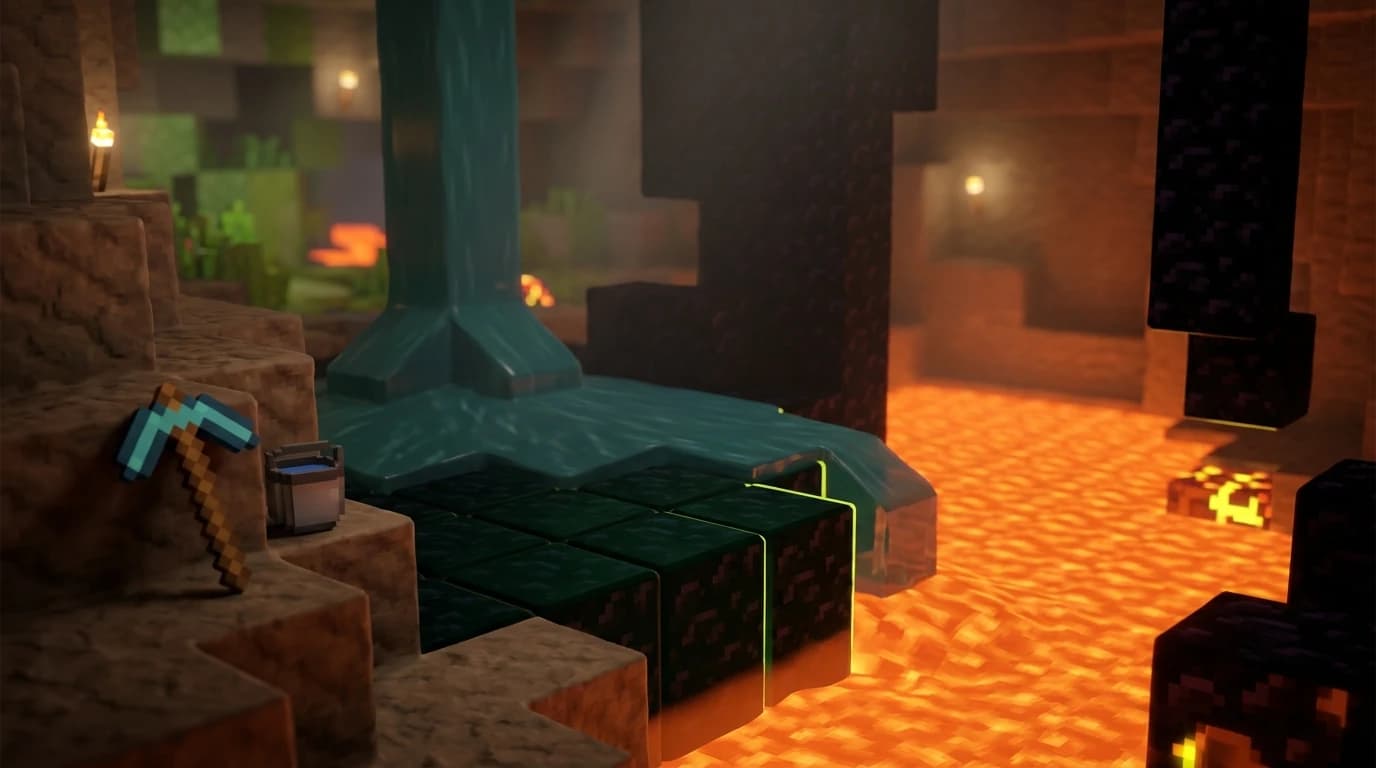
Obsidian is formed when flowing water touches a lava source block. You do not craft it at a crafting table, furnace, or stonecutter. Instead, you create the block in the world by controlling water and lava.
The simplest setup requires:
- One water bucket
- A lava pool or another reliable source of lava
- A diamond or netherite pickaxe for harvesting the block
- Building blocks to control the lava, if needed
Turn a lava pool into obsidian
- Find a pool of stationary lava. Large pools on the surface or underground are useful because each visible lava source can become one obsidian block.
- Stand on a safe block beside the lava and place water so it flows across the pool.
- Let the water touch the lava source blocks. The source blocks change into obsidian.
- Collect the water with your bucket or leave it flowing while you mine.
- Mine the obsidian with a diamond or netherite pickaxe.
Use caution around deep lava pools. Cover the area one layer at a time, and keep solid blocks nearby so you can block unexpected lava flows. Placing water above the obsidian can make mining slower and can push you toward open lava, so placing water beside the pool is usually safer.
How obsidian forms from water and lava
The difference between lava sources and flowing lava is the key to making obsidian. A lava source is a full, stationary lava block. When water touches it, the source changes into obsidian.
Flowing lava behaves differently:
- Water touching a lava source creates obsidian.
- Water touching flowing lava usually creates cobblestone.
- Lava flowing over water does not give you a reliable obsidian farm.
For this reason, the top layer of a lava lake is the easiest target. Pour water across the visible surface, then remove the obsidian layer and expose the next lava sources underneath. Always check below each block before mining because a lava pocket may be directly underneath.
How to mine obsidian in Minecraft
Obsidian drops itself only when you break it with a diamond or netherite pickaxe. An iron, stone, gold, copper, or wooden pickaxe can damage the block, but it does not drop obsidian. Breaking it with your hand also gives you nothing.
Use the correct pickaxe
- Diamond pickaxe: The first practical tool that can harvest obsidian.
- Netherite pickaxe: Also harvests obsidian and breaks it faster.
- Any weaker pickaxe: Fails to produce an obsidian item.
Obsidian is slow to mine, even with the correct tool. Efficiency increases mining speed, while Unbreaking and Mending help your pickaxe survive longer projects. Keep the water flowing over the area as you work so exposed lava turns into obsidian instead of burning you.
Mine a lava pool safely
- Pour water over the visible lava.
- Mine one obsidian block at a time from the edge.
- Wait for the water to cover the newly exposed area.
- Replace the water or move it forward as you clear the pool.
- Stop when you reach an unsafe drop or run low on tool durability.
Do not stand directly above a block while mining it if lava may be underneath. A safer method is to place a block beside the obsidian, mine from the side, and keep water between you and any exposed lava.
Where to find obsidian in Minecraft
You do not always need to make obsidian yourself. Several natural structures and loot sources provide it, although mining a lava pool is usually the most dependable early-game method.
- Overworld lava pools: Pour water over the lava to create a large supply.
- Ruined portals: Their incomplete frames contain regular obsidian and may include crying obsidian.
- Nether fortress chests: Some fortress chest loot can include obsidian.
- Weaponsmith chests: Villages with a weaponsmith may have obsidian in the chest.
- Piglin bartering: Giving a piglin a gold ingot can sometimes produce obsidian.
- The End: The entry platform is made from obsidian, and End structures also contain large obsidian formations.
Ruined portals are especially useful when you want enough blocks to repair a Nether portal without mining a full lava pool. Check the frame carefully because crying obsidian looks similar but cannot replace regular obsidian in an active Nether portal.
How to farm obsidian repeatedly
Obsidian is renewable because lava can be collected repeatedly. A common long-term setup uses pointed dripstone, lava above the dripstone, and a cauldron underneath. When the cauldron fills, collect the lava with a bucket and pour it into a controlled area where water can convert it into obsidian.
Basic renewable lava method
- Place a cauldron on a solid floor.
- Put pointed dripstone above the cauldron.
- Place a lava source above the dripstone with a solid block separating the lava from the dripstone.
- Wait for the cauldron to fill with lava.
- Collect the lava with a bucket.
- Place the lava where water can turn it into obsidian.
This method is slower than mining a natural lava lake, but it supplies lava without permanently consuming a pool. For large projects, use several identical cauldrons and a safe obsidian-making area with walls, water channels, and a roof over the work zone.
Another renewable source is the End entry platform. The platform regenerates when an entity enters the End, allowing you to mine it again. This is useful later in the game, but it is not a convenient early survival method because reaching and safely using the End requires substantial preparation.
What regular obsidian is used for
Obsidian is mainly a progression and defense block. Its high blast resistance makes it useful for protected rooms, bases, tunnels, and redstone areas. It is also required for several important recipes and structures.
- Nether portals: A standard portal frame needs at least 10 regular obsidian blocks when the four corners are omitted.
- Enchanting tables: The recipe uses four obsidian blocks, two diamonds, and one book.
- Ender chests: The recipe uses eight obsidian blocks and one Eye of Ender.
- Beacons: The recipe uses three obsidian blocks, five glass, and one Nether Star.
- End crystals: The recipe uses one obsidian block, seven glass, and one Eye of Ender.
Obsidian is also a strong building material, but it is expensive to gather and has a dark appearance that may not suit every build. Use it where durability matters, such as around valuable storage or dangerous machinery.
What crying obsidian does
Crying obsidian is a separate block with a purple color, glowing particles, and a light level. Its main practical use is crafting a respawn anchor, which lets you set a respawn point in the Nether. It cannot be used as a regular Nether portal frame.
You can obtain crying obsidian from ruined portals or by bartering with piglins. It can also appear in certain generated loot. Like regular obsidian, it requires a diamond or netherite pickaxe to harvest.
A respawn anchor uses six crying obsidian and three glowstone. After crafting it, place the anchor in the Nether and charge it with glowstone. The anchor can hold up to four charges. Using it in the Overworld or End causes an explosion instead of safely setting your respawn point, so only charge and use it in the Nether.
Common mistakes when getting obsidian
- Using the wrong pickaxe: An iron pickaxe can break the block visually but does not drop obsidian.
- Pouring water on flowing lava: This usually produces cobblestone rather than obsidian.
- Mining without checking below: Lava often sits directly under the surface of a pool.
- Confusing crying obsidian with regular obsidian: Crying obsidian cannot complete a Nether portal.
- Using a respawn anchor outside the Nether: It explodes in the Overworld and End.
- Mining too quickly with low durability: Obsidian takes a long time to break, so carry a spare pickaxe for large projects.
If you need only a few blocks, search a ruined portal or barter with piglins. If you need dozens of blocks for a base, convert a lava pool with water or build a renewable lava setup. For the safest result, work from the edge, keep water covering exposed lava, and use a diamond or netherite pickaxe from start to finish.