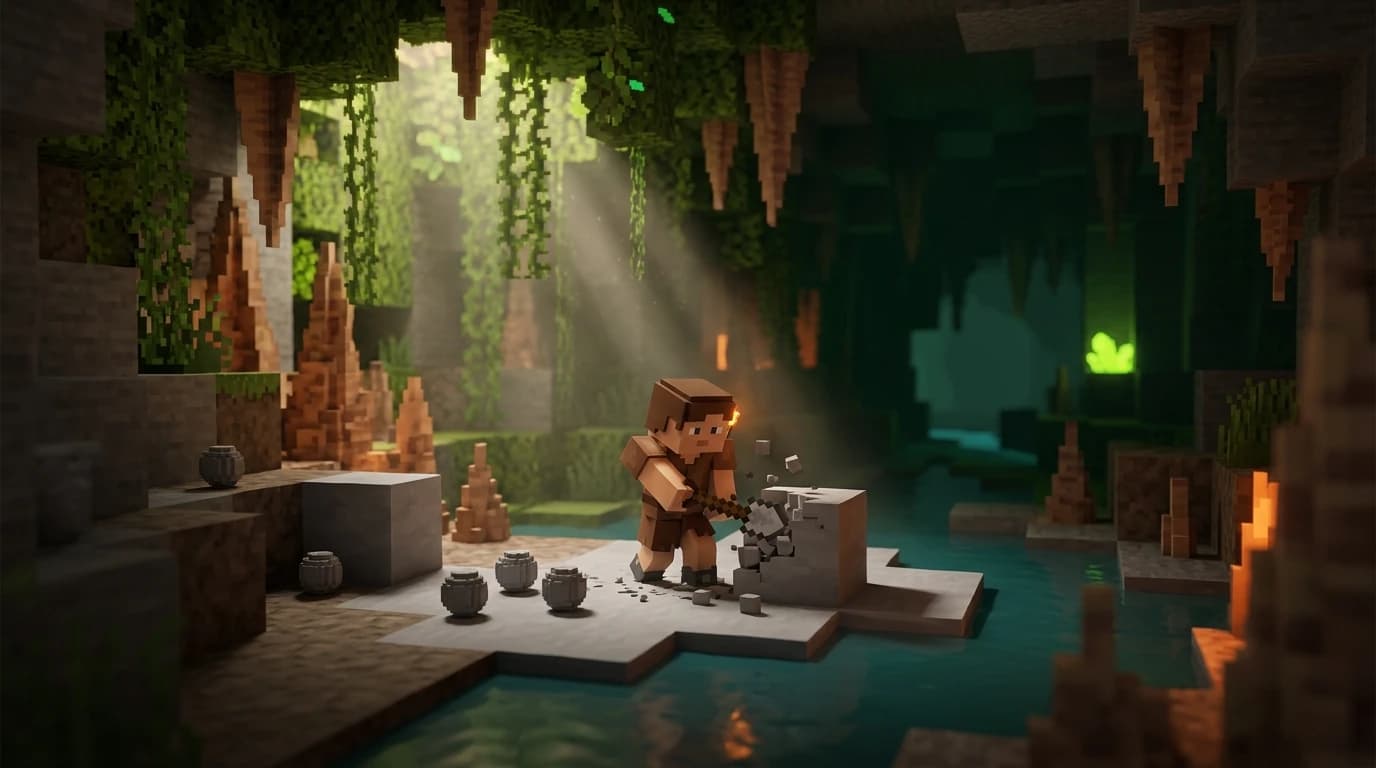
To answer how do I get clay in Minecraft, search shallow water in rivers, lakes, oceans, swamps, beaches, and lush caves. Mine the gray blocks with a shovel to receive four clay balls each. You can also turn mud into clay by placing mud above pointed dripstone, creating a renewable supply.
Where to find clay in Minecraft
Clay generates most commonly underwater, where it appears as light gray blocks on the floor. You can find it in several Overworld locations, so check nearby water before traveling far from your base.
- Rivers: Search shallow riverbeds, especially along bends and wider sections.
- Lakes and ponds: Small bodies of water often contain exposed clay patches.
- Swamps: Look beneath shallow water and around muddy shorelines.
- Beaches and oceans: Check underwater shelves near the coast.
- Lush caves: Clay can generate in large quantities on cave floors and in underground clay blobs.
Clay is usually easy to recognize because it has a muted gray color and a slightly speckled texture. It can be hidden beneath water, sand, gravel, or other blocks, so explore the edges of a patch if the first few blocks do not provide enough.
How to mine clay quickly
You can break clay with any tool or with your hand, but a shovel is the fastest choice. A normal clay block drops four clay balls when mined without Silk Touch.
- Craft or equip a shovel.
- Swim to a clay patch in shallow water or a lush cave.
- Break the clay blocks with the shovel.
- Collect the clay balls before they float away or become difficult to see underwater.
Bring doors, signs, water-breathing potions, or a helmet with the Respiration enchantment if you plan to mine a large underwater deposit. Doors and signs can create an air pocket in some situations, while a water-breathing potion lets you work without repeatedly surfacing.
Fortune does not increase the number of clay balls dropped from a clay block. Silk Touch changes the result instead: a Silk Touch tool gives you the clay block itself, which is useful when you want to move or decorate with the block without converting it into balls.
How to get clay from clay balls
If you already have clay balls, you can combine four of them to recreate one clay block. This is useful for storage, building, and smelting clay into terracotta.
| Recipe | Ingredients | Result |
|---|---|---|
| Clay block | 4 clay balls | 1 clay block |
Place one clay ball in each corner of a crafting table, or place four clay balls together in any 2-by-2 arrangement inside the crafting grid. The recipe does not require a particular shape as long as all four clay balls are used.
You can also leave the clay as balls and smelt them individually. One clay ball smelted in a furnace, blast furnace, or smoker produces one brick item. Four brick items can then be crafted into a brick block.
How to turn mud into clay
Mud provides the most dependable long-term method because clay made this way is renewable. You need mud, a dripstone block, and pointed dripstone. The pointed dripstone must hang beneath the block supporting the mud.
Make mud
Use a water bottle on a dirt block to turn it into mud. You can fill glass bottles from a water source, then use each bottle on dirt. Mud also generates naturally in mangrove swamps and can be collected with a shovel.
- Dirt blocks
- Glass bottles
- Access to water
- Dripstone blocks
- Pointed dripstone
Build the clay conversion setup
- Place a dripstone block as the upper support.
- Attach pointed dripstone to the underside of the dripstone block.
- Place a mud block directly above the supporting block or arrangement with pointed dripstone beneath it.
- Wait for the mud to dry and change into clay.
- Mine the finished clay block and replace it with another mud block.
The conversion takes time, so build several stations in parallel if you need a large amount. A simple line of dripstone blocks with pointed dripstone beneath each one lets you process multiple mud blocks at once. This method works in the Overworld, but mud does not convert into clay in the Nether.
What clay is used for in Minecraft
Clay has two main forms: the clay block and the clay ball. Mining a clay block gives clay balls, while four clay balls craft back into one block. Each form is useful for a different recipe.
Craft bricks
Smelt clay balls in a furnace to make brick items. Four brick items craft into one brick block. Bricks are useful for walls, chimneys, paths, foundations, and traditional-style houses.
Make terracotta
Place a clay block in a furnace with any fuel to smelt it into terracotta. Terracotta is a durable decorative block with a warm, earthy color and a smoother appearance than bricks.
Make colored terracotta
Terracotta can be dyed in all 16 standard colors. Place eight terracotta blocks around one matching dye in a crafting table. The eight terracotta blocks fill every slot around the outside, and the dye goes in the center. The result is eight blocks of dyed terracotta.
After terracotta is dyed, its color cannot be removed or changed directly. Choose the dye carefully before crafting a large batch.
Make glazed terracotta
Smelt dyed terracotta in a furnace to create glazed terracotta of the same color. Glazed terracotta has a patterned surface and is mainly used for detailed floors, mosaics, arrows, borders, and geometric decorations.
Can you dye clay in Minecraft?
You cannot dye ordinary clay blocks or clay balls directly. The correct process is to smelt a clay block into terracotta first, then combine eight terracotta blocks with one dye.
- Mine clay and craft four clay balls into clay blocks if needed.
- Smelt the clay blocks in a furnace to make terracotta.
- Place eight terracotta blocks around one dye in a crafting table.
- Use the colored terracotta as a building block, or smelt it again to make glazed terracotta.
Do not confuse clay with terracotta. Clay is the raw material, terracotta is the smelted block, and dyed terracotta is the colored version used before making glazed terracotta.
Java Edition and Bedrock Edition differences
The main ways to find, mine, craft, smelt, dye, and renew clay work the same in current Java Edition and Bedrock Edition. Clay generates underwater and in lush caves in both editions, and mud can be converted into clay with pointed dripstone in both editions.
The practical differences are mostly controls, water movement, and how easy it is to manage an underwater mining area. The recipe quantities and the basic clay-to-terracotta progression do not change between the two editions.
Best method for a large clay supply
For a quick project, mine clay from a river, lake, swamp, or lush cave. This is faster than building a conversion farm when you only need a few stacks.
For a large construction project, create a mud-to-clay setup near your base. Convert dirt into mud with water bottles, place the mud over pointed dripstone, and keep several conversion stations running. Use a shovel with Efficiency for faster collection, but do not rely on Fortune for extra clay balls.
If you need terracotta rather than clay balls, mine or produce clay blocks with Silk Touch when possible. Otherwise, craft four clay balls back into each block before smelting. Keep a separate furnace running for clay blocks while another furnace handles fuel-intensive building materials.
The most common mistake is looking only in deep ocean water. Clay is easier to spot and mine in shallow rivers, ponds, and lush caves. If no natural deposit is nearby, the mud-and-dripstone method gives you a permanent alternative.