To answer how do i make a lead in minecraft, place four string and one slimeball in a 3×3 crafting table using the hook-shaped recipe below. The result is two leads. You can also find leads in some generated structures or get them from wandering trader llamas if you do not have a slimeball.
How Do I Make a Lead in Minecraft?
A lead, also called a leash or lead rope, lets you pull certain animals and mobs behind you or tie them to a fence. It is especially useful for bringing horses, cows, sheep, pigs, llamas, and other animals back to your base.
| Ingredient | Quantity | How to get it |
|---|---|---|
| String | 4 | Defeat spiders, break cobwebs with a sword, or find it in some chests |
| Slimeball | 1 | Defeat slimes or obtain one through certain trades |
| Crafting result | 2 leads | Crafted at a crafting table |
The recipe gives you two leads, so one crafting operation is enough to move two animals at the same time.
Crafting-grid layout
Open a crafting table and place the ingredients in this pattern:
- String in the top-left square
- String in the top-middle square
- String in the middle-left square
- Slimeball in the center square
- String in the bottom-right square
Leave every other square empty. The arrangement forms a diagonal hook around the slimeball. Once the lead appears in the result slot, move it into your inventory.
How to Find the Ingredients
Getting string
String is usually the easier ingredient. Spiders drop it when defeated, and cobwebs drop string when broken with a sword. You can also find string in chests and obtain it from some village-related loot sources.
If you need four string quickly, search for spiders at night or explore a dungeon, mineshaft, or abandoned structure where cobwebs are common. Keep your sword ready because breaking cobwebs by hand takes much longer and does not give you the useful drop.
Getting a slimeball
Slimeballs come from slimes. Slimes can appear in swamp areas and in specific underground slime chunks. A swamp is usually the more practical option for an early slimeball because you can search at night without first building a dedicated farm.
Slimeballs can also come from wandering trader offers in some situations. If you already have access to a trader, check the available trades before spending time searching underground.
Can You Make a Lead in Minecraft Without Slime?
No. The standard vanilla crafting recipe requires one slimeball and four string. There is no alternate crafting pattern that replaces the slimeball with wool, leather, iron, or another item.
You can still get a lead without collecting a slimeball by finding one as loot or taking one from a wandering trader’s llamas. These methods give you a lead directly, but they do not change the crafting recipe.
Find leads in generated structures
Leads can appear as structure loot in places such as woodland mansions and ancient cities. Leads can also be found through suspicious gravel in trail ruins. In Bedrock Edition, buried treasure is another possible source.
Loot availability and structure generation depend on your edition and game version, so searching for a generated lead is less predictable than crafting one. It is a useful backup when you have string but cannot find a slimeball.
Get leads from wandering trader llamas
A wandering trader normally appears with two trader llamas attached by leads. If a llama becomes separated from the trader, its lead can drop at the llama’s position. You can also use a boat or minecart to separate a llama from the trader and collect the dropped lead.
This is one of the earliest ways to get leads without fighting slimes. Protect the llamas while you detach them, then pick up the leads before they disappear.
How to Use a Lead on Animals
- Place the lead in your hotbar and select it.
- Use the lead on a leashable animal or mob.
- Walk away slowly so the animal follows you.
- Use the lead on a fence to tie the animal in place.
On a computer, using the lead normally means right-clicking the animal. On a console or mobile device, use the platform’s standard interact button. The exact button depends on your control settings.
You can attach leads to many passive and neutral mobs, including horses, donkeys, mules, cows, sheep, pigs, chickens, rabbits, llamas, goats, wolves, cats, and iron golems. Some additional mobs can also be leashed, but villagers are not normally leashable in vanilla survival.
Tie a mob to a fence
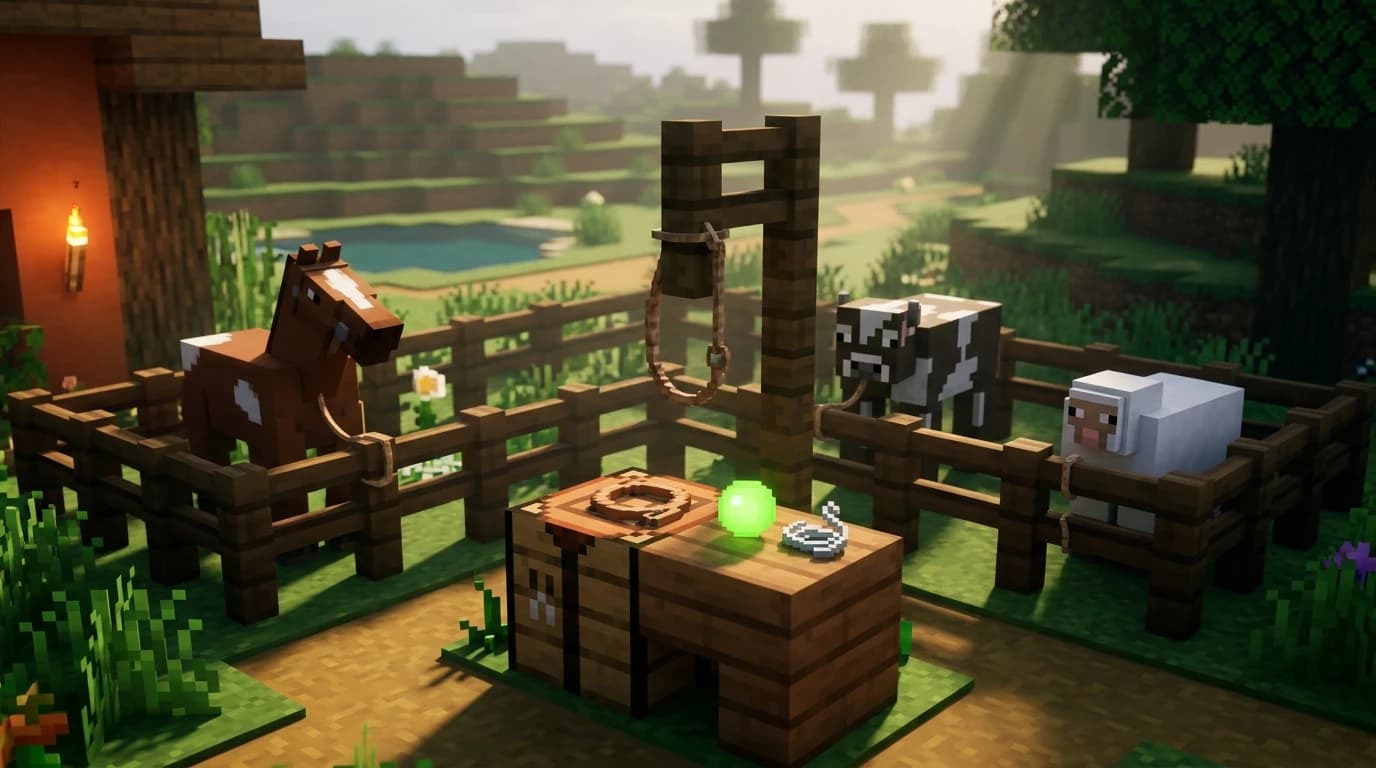
With the animal attached, use the lead on a fence post. A visible leash knot appears, and the animal stays near that post. You can attach multiple leads to one fence, which makes fence pens useful for organizing breeding animals, horses, or llamas.
Use the lead on the animal again to release it. You can also break the leash knot directly. When a lead is removed, it drops near the animal so you can pick it up and reuse it.
Lead distance and break points
A lead can stretch up to 10 blocks between the player and the attached mob, or between a mob and its fence knot. If the animal gets too far away, the lead snaps. Solid barriers, sudden movement, and dangerous terrain can also cause problems.
Move at a steady pace and avoid pulling animals around sharp corners. For long journeys, clear a path first or use boats and minecarts to cross water and transport mobs more reliably.
How to Lead Villagers in Minecraft
You cannot attach a lead to a villager in normal vanilla survival gameplay. Villagers do not accept leads the way animals do, so trying to use one on a villager will not move it.
To transport villagers, use a boat, a minecart, or a controlled path through blocks and trapdoors. Boats work well on land and water, while minecarts are faster when you have rails available. Build a protected route before moving a villager because zombies, falls, and accidental openings can permanently ruin the trip.
Commands, map editors, and specialized add-ons can change how villagers behave, but those are not part of the standard survival recipe or vanilla mechanic.
Java and Bedrock Lead Differences
The crafting recipe is the same in Java Edition and Bedrock Edition: four string plus one slimeball creates two leads. The main uses are also the same, including attaching leads to suitable mobs and tying them to fences.
- Bedrock Edition can generate leads in buried treasure, while buried treasure is not a standard lead source in Java Edition.
- Bedrock Edition allows leads to be attached to walls in situations where Java Edition uses fence posts instead.
- Structure loot tables can differ between editions, so the chance of finding a lead in a particular structure is not always identical.
Neither edition lets you leash villagers through ordinary vanilla survival interaction. Use boats or minecarts when moving villagers.
Common Lead Mistakes and Faster Alternatives
- Using the wrong recipe: A lead needs four string and one slimeball. Wool does not work.
- Expecting one lead: The recipe produces two leads, so check the result slot carefully.
- Pulling animals too far: Keep the animal within 10 blocks to prevent the lead from snapping.
- Trying to leash villagers: Use a boat or minecart instead.
- Transporting animals across oceans: Put the animal in a boat when possible instead of relying on a stretched lead.
- Losing leads at a base: Tie animals to fence posts inside a closed pen and keep the area protected from hostile mobs.
For most worlds, the fastest reliable method is to collect string from spiders, find one slimeball, and craft the leads at a table. If you are still early in the game and cannot locate a slime, watch for a wandering trader and use its llamas as a free source of leads.