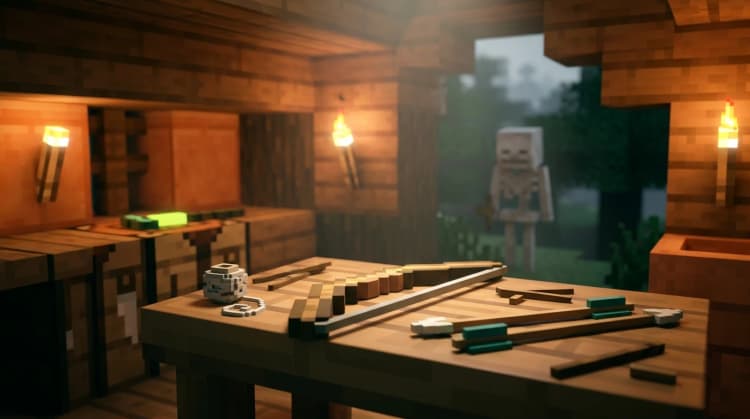
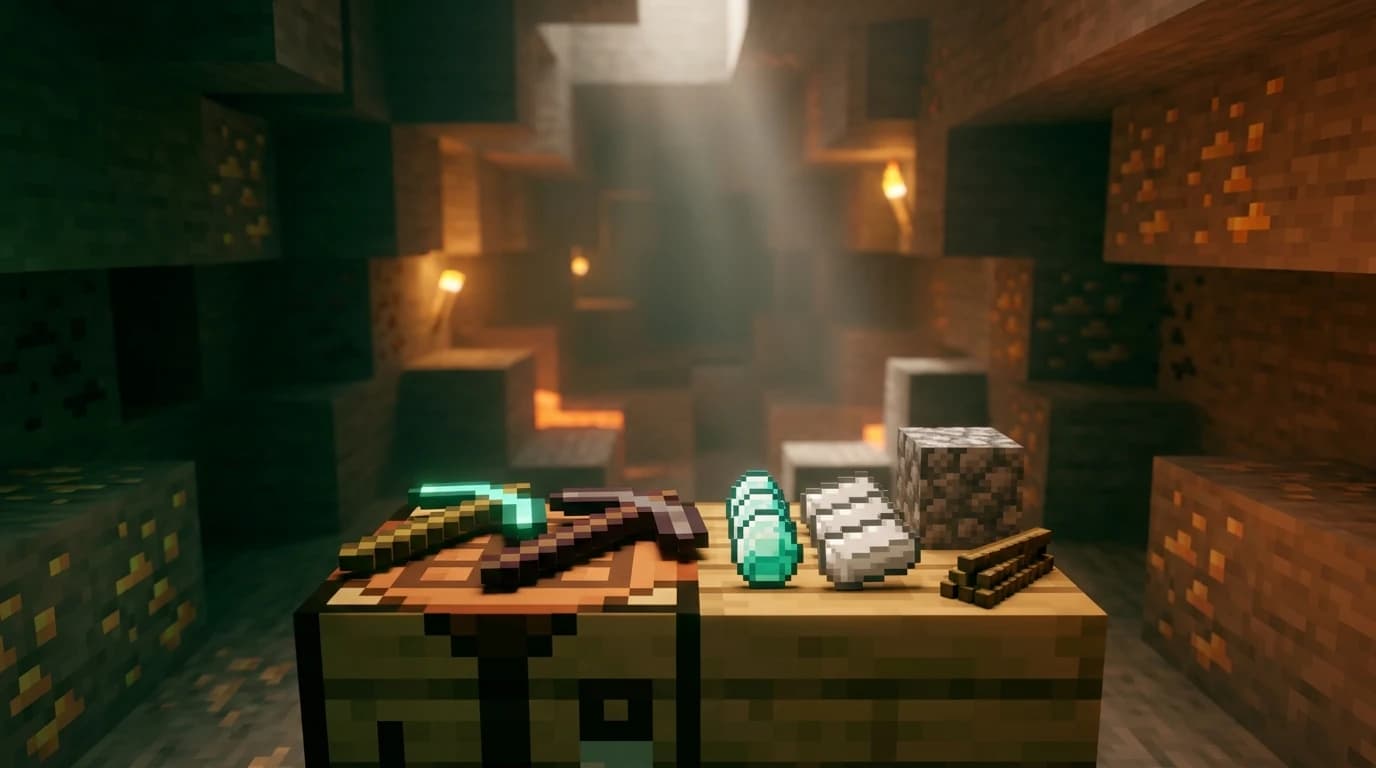
To answer how do i make a pickaxe in minecraft, use a crafting table and place three matching materials across the top row, then put two sticks in the center column. Use planks for wood, cobblestone for stone, iron ingots, gold ingots, or diamonds for higher tiers. Netherite requires a smithing table.
How do i make a pickaxe in minecraft
The basic pickaxe recipe works the same way for wooden, stone, iron, golden, and diamond pickaxes. You need a crafting table because the recipe uses a three-by-three grid.
| Pickaxe | Top-row material | Sticks | Result |
|---|---|---|---|
| Wooden pickaxe | 3 planks | 2 sticks | 1 wooden pickaxe |
| Stone pickaxe | 3 cobblestone | 2 sticks | 1 stone pickaxe |
| Iron pickaxe | 3 iron ingots | 2 sticks | 1 iron pickaxe |
| Golden pickaxe | 3 gold ingots | 2 sticks | 1 golden pickaxe |
| Diamond pickaxe | 3 diamonds | 2 sticks | 1 diamond pickaxe |
The crafting-grid layout is simple: place the three matching materials across the entire top row. Place one stick in the center square of the middle row and one stick in the center square of the bottom row. Leave the other four squares empty.
Make sticks first
If you do not have sticks, place two planks vertically in the crafting grid. This produces four sticks, enough for two pickaxes. Any overworld wood type works, including oak, spruce, birch, jungle, acacia, dark oak, mangrove, cherry, and bamboo planks.
Craft a crafting table
- Open your four-square inventory crafting grid.
- Place four matching planks into the four squares.
- Move the crafting table into your hotbar.
- Place it in the world and open it to access the three-by-three grid.
What you need for each pickaxe tier
Pickaxe materials control mining speed, durability, and which blocks you can collect. The normal early-game progression is wooden pickaxe, stone pickaxe, iron pickaxe, diamond pickaxe, and finally netherite pickaxe.
- Wooden: Use three planks and two sticks. It is mainly a starter tool for collecting stone.
- Stone: Use three cobblestone and two sticks. It is the cheapest practical early-game pickaxe.
- Iron: Use three iron ingots and two sticks. It mines faster and can collect ores such as gold, redstone, lapis lazuli, diamond, and emerald.
- Gold: Use three gold ingots and two sticks. It mines very quickly but breaks easily, so it is rarely the best survival choice.
- Diamond: Use three diamonds and two sticks. It is durable and can mine obsidian and other blocks that require diamond tier.
- Netherite: Upgrade a diamond pickaxe instead of crafting it directly.
Your first wooden pickaxe should usually collect stone, coal, and cobblestone. Craft a stone pickaxe as soon as possible. After you find iron, make an iron pickaxe because it is a strong everyday tool and lets you collect valuable ores. Save diamonds for a diamond pickaxe before spending them on less essential diamond tools.
How to make a netherite pickaxe
A netherite pickaxe is made by upgrading a diamond pickaxe at a smithing table. You need a diamond pickaxe, one Netherite Upgrade Smithing Template, and one netherite ingot. The upgrade keeps the diamond pickaxe's enchantments, custom name, and remaining durability.
- Place a smithing table.
- Put the Netherite Upgrade Smithing Template in the left slot.
- Put your diamond pickaxe in the center slot.
- Put one netherite ingot in the right slot.
- Move the netherite pickaxe into your inventory.
You find the Netherite Upgrade Smithing Template in bastion remnant treasure. You can duplicate one with diamonds, netherrack, and the template itself, so keep a template safe once you obtain it. A netherite ingot requires four netherite scraps and four gold ingots.
Choosing the right pickaxe tier
The best pickaxe depends on what you are mining and how much material you have. A stone pickaxe is ideal for gathering cobblestone and common blocks early in a world. An iron pickaxe is the best general-purpose choice during much of survival because iron is renewable through mining and farms, while the tool is considerably faster and more durable than stone.
Use an iron pickaxe to mine diamond ore, redstone ore, gold ore, emerald ore, and obsidian. A wooden or stone pickaxe can break some of these blocks, but it will not drop the resource. A diamond pickaxe is required for obsidian and ancient debris, making it important before entering the Nether for serious progression.
Diamond is usually the best first high-value pickaxe. Once you have enough ancient debris, netherite is the strongest standard option because it is faster, more durable, and does not burn in lava. Golden pickaxes are fast but fragile, and gold tools cannot mine the valuable blocks that require stronger tiers.
For practical survival, keep at least two specialized endgame pickaxes:
- Fortune pickaxe: Use it for ores and blocks that produce multiple drops.
- Silk Touch pickaxe: Use it when you want the block itself, such as stone, glass-related blocks, or ore blocks.
Getting the best pickaxe enchantments
The strongest all-purpose pickaxe is usually a netherite pickaxe with Efficiency V, Unbreaking III, Mending, and either Fortune III or Silk Touch. Fortune and Silk Touch cannot be placed on the same pickaxe, so most late-game players make one of each.
| Enchantment | Maximum level | What it does |
|---|---|---|
| Efficiency | V | Increases mining speed. |
| Unbreaking | III | Reduces how often durability is consumed. |
| Mending | I | Uses collected experience to restore durability. |
| Fortune | III | Increases drops from many ores and resource blocks. |
| Silk Touch | I | Makes certain blocks drop themselves instead of their normal drops. |
| Curse of Vanishing | I | Deletes the pickaxe when you die instead of dropping it. |
For a mining and resource pickaxe, choose Efficiency V, Unbreaking III, Mending, and Fortune III. For construction, storage, and collecting blocks, choose Efficiency V, Unbreaking III, Mending, and Silk Touch. Fortune is especially useful for increasing the yield from ores, while Silk Touch lets you transport blocks such as stone, glass-related blocks, and ore blocks without converting them into their usual drops.
You can enchant a pickaxe with an enchanting table, combine it with enchanted books on an anvil, or combine two compatible pickaxes. Mending is commonly obtained through enchanted books rather than directly from an enchanting table.
How to repair a pickaxe
You have four practical ways to repair a pickaxe: combine two matching pickaxes, use an anvil with the correct material, use an anvil with another pickaxe, or apply Mending.
Repair with an anvil
Place the damaged pickaxe in the first anvil slot and its tier material in the second slot. Use planks for a wooden pickaxe, cobblestone for stone, iron ingots for iron, gold ingots for gold, diamonds for diamond, and netherite ingots for netherite. An anvil repair preserves enchantments but costs experience levels.
You can also combine two pickaxes of the same material in an anvil. This repairs the first item and combines compatible enchantments, but the experience cost increases as the items receive more anvil work.
Repair with a crafting grid or grindstone
Place two damaged pickaxes of the same material into a crafting grid or grindstone. The result has increased durability, but normal enchantments are removed. Use this method for unenchanted tools or when you intentionally want to clear unwanted enchantments.
A grindstone can also remove most enchantments from a single pickaxe and return some experience. It does not remove curses. Do not use it on a valuable Fortune, Silk Touch, or Mending pickaxe unless you are willing to lose those enchantments.
Repair with Mending
Mending is the most convenient long-term solution. Hold or wear the damaged pickaxe while collecting experience orbs. The experience repairs the tool instead of adding to your level whenever the game selects that item for repair. Keep the pickaxe equipped while mining ores, fighting mobs, trading, or collecting other experience.
Java Edition and Bedrock Edition differences
The pickaxe recipes, material tiers, basic enchantments, repair options, and netherite upgrade process are substantially the same in Java Edition and Bedrock Edition. The controls and crafting interface can look different on PC, console, and mobile, but the item arrangement does not change.
Use the recipe book if you cannot remember the pattern. Once you have the required ingredients, select the pickaxe recipe and let the interface place the materials automatically. This works on both major editions, although the buttons and menu layout depend on your device.
Common pickaxe mistakes to avoid
- Do not use a wooden pickaxe to mine ores that require stone, iron, or diamond tier. The block may break without dropping its resource.
- Do not craft a golden pickaxe for normal survival mining unless you specifically want its high speed and accept its low durability.
- Do not put Fortune and Silk Touch on the same pickaxe. They are incompatible.
- Do not repair an enchanted pickaxe in a crafting grid or grindstone unless you want to remove its normal enchantments.
- Do not spend diamonds on several basic tools before crafting a diamond pickaxe. It is one of the most important progression items.
- Do not keep using an expensive pickaxe until it has only a few durability points left. Repair it early, or add Mending before it breaks.
If you only need a tool immediately, craft a wooden pickaxe, collect cobblestone, and replace it with stone within minutes. If you are preparing for the Nether, work toward a diamond pickaxe first, then add Mending, Unbreaking, and Efficiency before upgrading it to netherite.