To answer how do you breed villagers in Minecraft, place at least three reachable beds in a safe area, bring two adult villagers together, and give each villager either 3 bread or 12 carrots, potatoes, or beetroots. They produce a baby when both villagers are willing and the extra bed has room for it.
How do you breed villagers in Minecraft?
Villager breeding does not require a job, a village building, or a special block. You need two adult villagers, enough food, and one unclaimed bed for every villager you want in the area. For the first baby, that means two adult villagers and at least three valid beds.
- Two adult villagers that can reach each other.
- Three beds for two adults and one baby.
- At least two blocks of open space above each bed.
- Food for both villagers: 3 bread or 12 carrots, potatoes, or beetroots per villager.
- A secure enclosure that protects the villagers from zombies and other hostile mobs.
The beds must be reachable, not merely placed nearby. If a bed is blocked, already claimed, or impossible for a villager to pathfind toward, the breeding attempt can fail. Add extra beds as the population grows. In Java Edition, villagers can breed when an unclaimed bed is reachable within the village mechanics range; Bedrock Edition also checks the village population against available beds. ([minecraft.fandom.com](https://minecraft.fandom.com/wiki/Villager?utm_source=openai))
Gather the food and beds
Food required for breeding
Each villager needs enough food in its inventory to become willing. The easiest option is bread because 3 bread gives one villager the required amount of food. You can also throw 12 carrots, 12 potatoes, or 12 beetroot to each villager.
| Food | Amount per villager | Amount for two villagers |
|---|---|---|
| Bread | 3 | 6 |
| Carrots | 12 | 24 |
| Potatoes | 12 | 24 |
| Beetroots | 12 | 24 |
Stand near the villagers and drop the food on the ground. They pick it up automatically if they have inventory space and mob griefing is enabled. Bread is usually the fastest option because it takes fewer individual items to satisfy both villagers.
Place the beds correctly
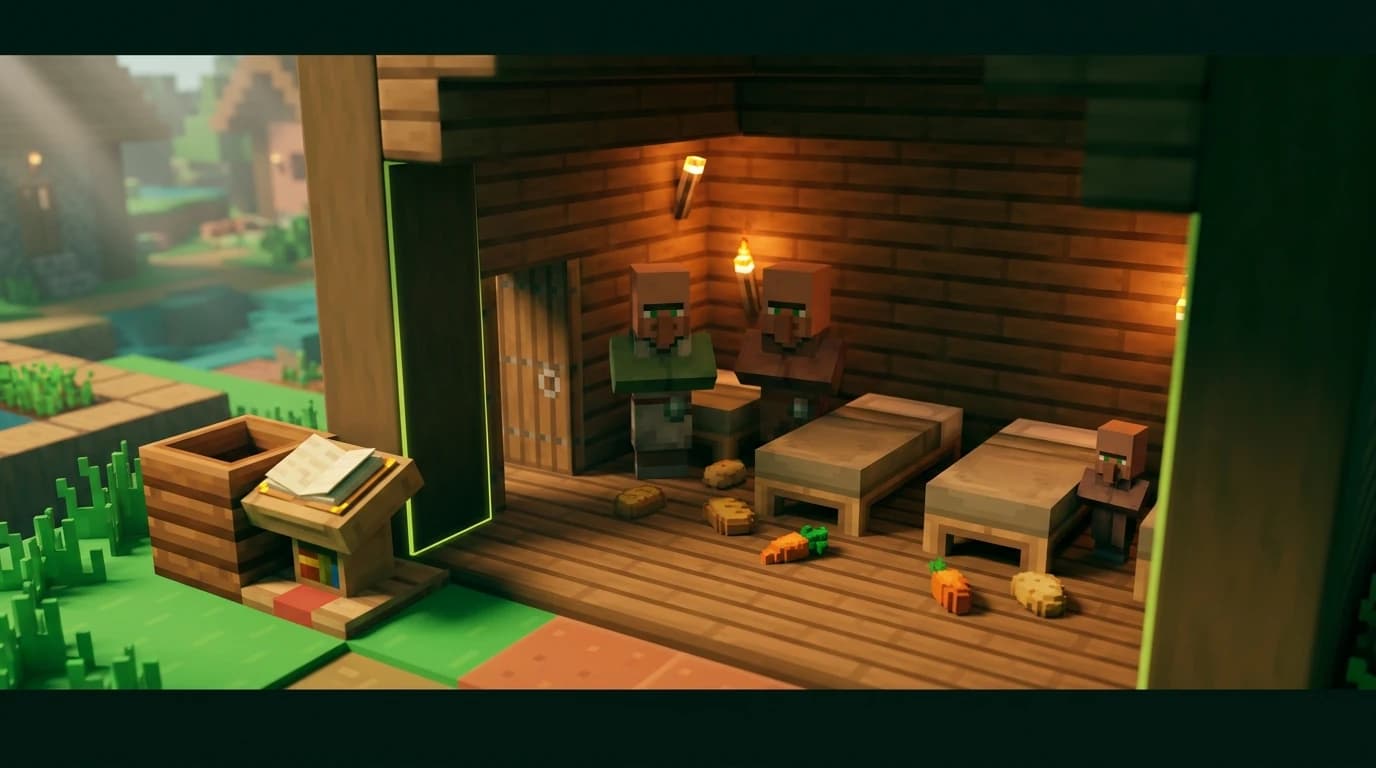
Place three beds inside the enclosure, leaving clear access to the pillow end of each bed. Keep the area above the beds open so villagers can recognize and use them. A solid block directly over a bed can prevent it from counting as a valid bed for breeding.
For a larger villager farm, place one additional bed for every baby you want to keep. A simple rule is one bed per villager, with no blocked paths. Remove spare beds from nearby houses if villagers keep claiming beds outside your breeding area.
Build a simple villager breeder
- Make a fenced or walled room that is safe from zombies, husks, and other hostile mobs.
- Bring two adult villagers into the room using a boat, minecart, or a nearby village path.
- Place three beds in the room, with open space above them and a clear path to each bed.
- Throw 6 bread, 24 carrots, 24 potatoes, or 24 beetroots toward the two villagers.
- Wait while the villagers pick up the food and show heart particles.
- Check for a baby villager. If angry particles appear instead, inspect the beds, food, and pathfinding space.
Villagers have a breeding cooldown after a successful attempt, so they do not create babies continuously. They also need to be able to access the beds. A common breeder design places the adults beside a farm or feeding area and moves babies away from the extra beds, leaving new beds available for additional breeding.
How to breed villagers in Minecraft Bedrock
Villager breeding works in Bedrock Edition with the same basic ingredients: two adult villagers, enough food, and valid beds. The main practical difference is that Bedrock periodically counts villagers inside the village area. If the village population has reached the number supported by its beds, the adults stop breeding until you add another valid bed or move villagers away.
For Bedrock breeder designs, give every villager a bed and make sure the beds are part of the same village. Keep the enclosure separated from nearby villages, beds, and work areas if the population count seems higher than expected. Bedrock villagers can also become willing after trading, but food is still the simplest way to start a breeding cycle. ([minecraft.fandom.com](https://minecraft.fandom.com/wiki/Villager?utm_source=openai))
The same method applies to Minecraft PE because current mobile Minecraft uses Bedrock Edition. Use reachable beds, provide food, and protect the villagers from hostile mobs.
How to get and move villagers
Finding villagers
The normal way to get villagers is to find a generated village in a plains, desert, savanna, taiga, snowy, or swamp-related environment. If a village has two adult villagers, you can transport them to a safer base and breed more there.
You can also create a villager by curing a zombie villager. Use a Splash Potion of Weakness on the zombie villager, then use a Golden Apple on it. Keep it protected while the transformation finishes. A boat or minecart makes this process easier before and after curing.
Moving villagers without a lead
Villagers cannot be led with a standard lead. Use a boat on land, a minecart on rails, or carefully guide them through a prepared path. Boats work well on flat ground and across water, while minecarts are better for long-distance routes and vertical transport.
When moving villagers, block off nearby exits, light the route, and protect the destination before you start. A villager can wander into danger quickly, especially at night. Once the villagers arrive, place beds first so they establish the new village area before you add job blocks.
How to give a villager a job
To give an adult villager a profession, place its matching job-site block nearby. The villager must be unemployed, able to reach the block, and not be a nitwit. If you have already traded with that villager, its profession and trades are locked and will not change.
| Villager profession | Job-site block |
|---|---|
| Armorer | Blast Furnace |
| Butcher | Smoker |
| Cartographer | Cartography Table |
| Cleric | Brewing Stand |
| Farmer | Composter |
| Fisherman | Barrel |
| Fletcher | Fletching Table |
| Leatherworker | Cauldron |
| Librarian | Lectern |
| Mason | Stonecutter |
| Shepherd | Loom |
| Toolsmith | Smithing Table |
| Weaponsmith | Grindstone |
There is no single villager called a blacksmith. Armorer, toolsmith, and weaponsmith are the three smithing-related professions. A farmer uses a composter, and a librarian uses a lectern. To reroll an unemployed villager's trade, break and replace its job block before trading with it. Once you complete a trade, the villager keeps that profession.
The best villager depends on your goal. Librarians are valuable for enchanted books, farmers turn crops into emeralds and offer useful food, fletchers buy sticks for emeralds, and armorers, toolsmiths, and weaponsmiths can provide equipment. For a general-purpose trading hall, start with a librarian, farmer, and fletcher, then add the smithing professions you need. ([minecraft.fandom.com](https://minecraft.fandom.com/wiki/Villager?utm_source=openai))
How to name, spawn, and protect villagers
Naming a villager
To name a villager, rename a Name Tag in an anvil, then use the renamed tag on the villager. Renaming the tag costs one experience level, and the tag is consumed when you use it. Naming a villager is useful for identifying important traders, but it does not assign a profession or prevent the villager from taking damage.
Spawning or making a villager
You cannot craft a villager from ordinary ingredients. In survival, find villagers in villages or cure zombie villagers. With cheats enabled, you can use a villager spawn egg or the summon command. A summoned villager still needs a job-site block if you want it to become a working profession, and its behavior can differ between Java and Bedrock.
Keeping villagers alive
- Light the breeder and trading area to reduce hostile mob spawns.
- Use fences, walls, or blocks to prevent villagers from walking away.
- Protect them from zombies, raids, falling, fire, and accidental player attacks.
- Keep beds and job blocks assigned to the correct trading area.
- Do not trade with a villager until you are satisfied with its profession and offers.
Fix villager breeding problems
If the villagers show hearts but no baby appears, add another bed and make its pillow reachable. Make sure the bed has open space above it and remove beds claimed by villagers outside the breeder. If the villagers do not show hearts, give each one fresh food and check whether they can pick it up.
Angry particles usually mean the breeding attempt failed because the population limit was reached or the required bed was invalid. Separate the breeder from nearby villages, add more beds, and clear blocks that interfere with pathfinding. If villagers refuse to pick up food, check that mob griefing is enabled and that their inventories are not full.
For the fastest setup, use bread, three beds, a small roofed enclosure, and two villagers transported by boat or minecart. After the first baby grows into an adult, add another bed and repeat the process. This gives you a reliable supply of villagers for trading, farming, librarians, and equipment without searching for new villages.