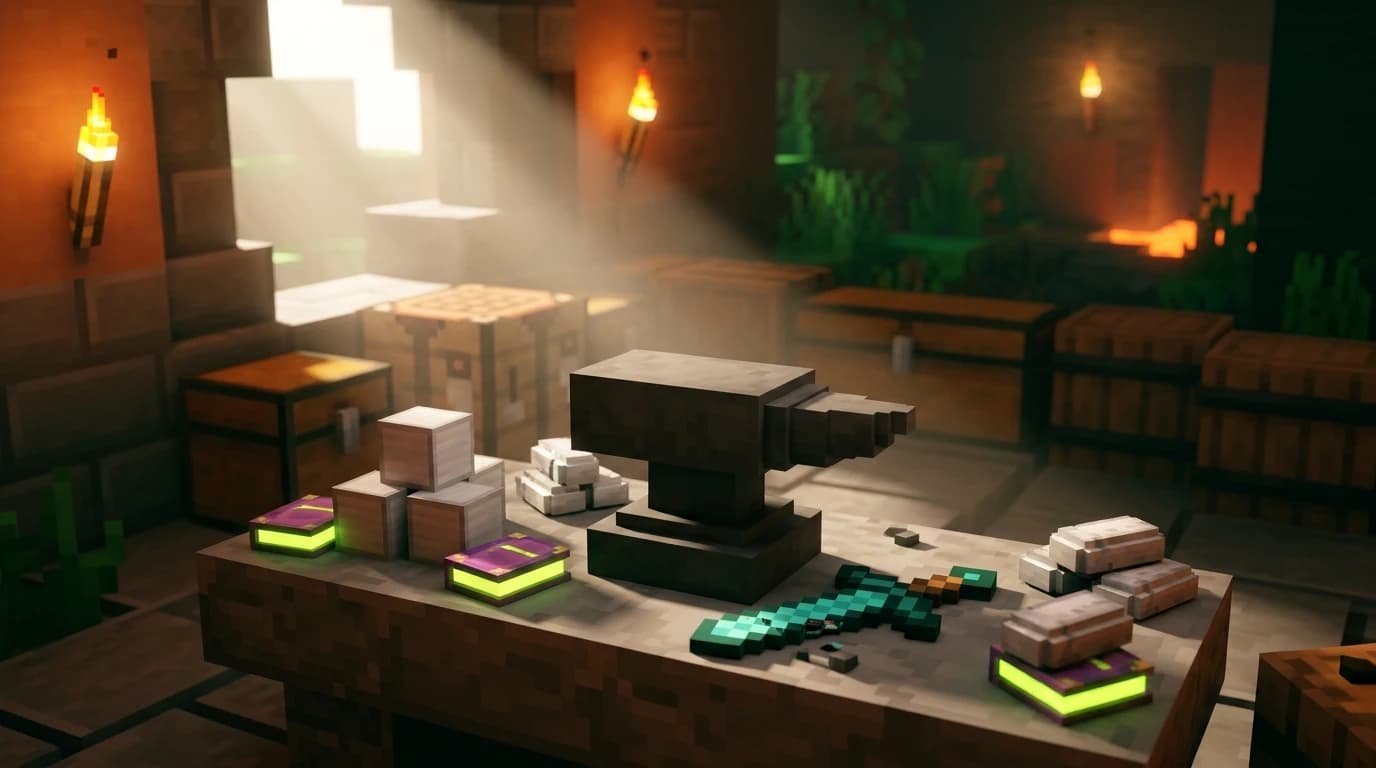
To make an anvil in Minecraft, use a crafting table with 3 iron blocks and 4 iron ingots. Put the 3 iron blocks across the top row, 1 iron ingot in the center, and 3 iron ingots across the bottom row. The recipe costs 31 iron ingots in total and gives 1 anvil.
How Do I Make an Anvil in Minecraft?
You need a crafting table because an anvil recipe uses the full 3-by-3 crafting grid. Gather the following materials before you start:
- 3 iron blocks
- 4 iron ingots
- 1 crafting table
Three iron blocks require 27 iron ingots because each block uses 9 ingots. Adding the 4 separate ingots brings the total cost to 31 iron ingots.
| Crafting ingredient | Quantity | Iron ingots required |
|---|---|---|
| Iron block | 3 | 27 |
| Iron ingot | 4 | 4 |
| Total | 7 placed items | 31 |
Craft the iron blocks
- Open your crafting table.
- Place 9 iron ingots in the grid to make 1 iron block.
- Repeat until you have 3 iron blocks.
Place the anvil ingredients
Open the crafting table and arrange the materials in this pattern:
- Top row: 3 iron blocks
- Middle row: 1 iron ingot in the center slot
- Bottom row: 3 iron ingots across the row
Leave the two outside slots in the middle row empty. The anvil appears in the result slot. Move it into your inventory, then place it wherever you want to use it.
What You Need to Gather Before Crafting
Iron is the only resource in the recipe, but 31 ingots is a significant amount for a new survival world. Mine iron ore underground, search for iron in generated loot, or use an iron farm once you have the necessary setup.
Smelt raw iron or iron ore in a furnace, blast furnace, or another furnace-type block that accepts iron. Convert the ingots into three iron blocks first, then keep four ingots aside for the center and bottom of the recipe.
If you are short on iron, do not accidentally convert every ingot into blocks. The recipe needs four individual ingots after you make the three blocks. You cannot substitute raw iron, nuggets, or another metal for any part of the recipe.
What Is an Anvil Used For?
An anvil is a utility block for improving and maintaining valuable equipment. It uses experience levels for many operations, so keep some XP available before combining enchanted gear or books.
- Repair damaged gear: Combine an item with its matching repair material, such as diamonds for diamond equipment or netherite ingots for netherite equipment.
- Combine two matching items: Put two compatible tools, weapons, or armor pieces together to increase durability while preserving useful enchantments.
- Apply enchanted books: Combine an enchanted book with a compatible item to add the book's enchantment.
- Combine enchantments: Merge compatible enchantments from two items of the same general type.
- Rename items: Give tools, weapons, armor, name tags, and many other items a custom name.
- Use falling damage: Anvils are affected by gravity and can hurt entities when they fall onto them.
Unlike a grindstone, an anvil normally keeps the enchantments on the item when you repair or combine it. That makes an anvil the better choice for maintaining high-level enchanted equipment.
How to Repair Items With an Anvil
Place the damaged item in the left input slot of the anvil interface. Add the appropriate repair material in the second slot, then check the output and experience cost.
Repair with materials
The repair material depends on the item. Iron equipment uses iron ingots, diamond equipment uses diamonds, and netherite equipment uses netherite ingots. An elytra uses phantom membranes, while a turtle shell uses scutes.
Each matching repair material restores part of the item's maximum durability. This method is useful when the item is valuable or enchanted, but it can become expensive if you repair the same item repeatedly.
Combine two items
Place two compatible items in the input slots. The output combines their durability and may combine their enchantments when those enchantments are compatible. The first item generally determines the name and the item that receives the final result, so swap the order if the displayed cost or enchantments are not what you want.
Repairing an item in your personal crafting grid usually removes enchantments. Use an anvil when you want to preserve the item's enchantments while restoring durability.
How to Use an Anvil for Enchantments and Names
Apply an enchanted book
- Place the item you want to enchant in the first slot.
- Place a compatible enchanted book in the second slot.
- Review the output and experience level cost.
- Take the upgraded item from the result slot.
The book must contain an enchantment that can apply to the item. For example, a sword can accept many weapon enchantments, while a pickaxe accepts mining-related enchantments. Incompatible enchantments do not transfer.
Combine enchantments efficiently
Combining items in a careful order can reduce the experience cost. Avoid repeatedly combining one finished item with many separate books if you can combine compatible books together first. Every prior anvil operation contributes to an item's work history, which can make later upgrades more expensive.
If the anvil says “Too Expensive!” in Survival or Adventure mode, the operation cannot be completed at that cost. Mending is often a better long-term solution for frequently used tools and armor because experience repairs the item directly.
Rename an item
Put any renameable item in the first slot and type a new name in the name field. Renaming costs experience when you take the result, and you can rename many items even if they have no durability bar. Name tags must be renamed on an anvil before you use them on a mob.
How Long Does an Anvil Last?
Anvils have limited durability. Each use has a chance to damage the anvil, changing it through increasingly worn states. A damaged anvil still works, but once it reaches its final damaged state, the next damaging event can destroy it.
You cannot repair an anvil with iron blocks or iron ingots. When one breaks, craft another using the same 31-ingot recipe. Because anvil damage is chance-based, one anvil may last longer or shorter than another.
Mine an anvil with a pickaxe if you need to move it. Breaking it without a suitable pickaxe can cause you to lose the block instead of dropping it as an item.
Java Edition and Bedrock Edition Differences
The anvil recipe and its main functions are the same in Java Edition and Bedrock Edition. Both versions use 3 iron blocks and 4 iron ingots, and both support repairing, combining, enchanting with books, and renaming.
The names displayed for damaged anvil states can differ between editions. Java commonly uses names such as “Chipped Anvil” and “Damaged Anvil,” while Bedrock may use different wording for the same worn states. This does not change how the block works.
Fastest Ways to Get an Anvil
Crafting is normally the most dependable way to get an anvil. If you already have enough iron, the recipe is faster than searching structures for one. In Creative mode, you can take an anvil from the inventory menu, and with cheats enabled you can use the appropriate give command.
In Survival, focus on collecting iron efficiently:
- Mine iron ore and smelt it into ingots.
- Check loot from structures for extra iron.
- Use a Fortune pickaxe on iron ore when you want more raw iron.
- Build an iron farm for a renewable supply in an established world.
Craft the anvil near your enchanting area, storage room, or trading hall so you can repair equipment and apply books without carrying it around.
Common Anvil Mistakes to Avoid
- Using the wrong grid: The recipe requires a crafting table, not the 2-by-2 inventory grid.
- Forgetting the total cost: Three iron blocks plus four ingots equals 31 iron ingots, not 7.
- Repairing too often: Repeated anvil work raises future experience costs.
- Choosing the wrong input order: Swap the item positions if the output keeps the wrong name or gives an inefficient enchantment result.
- Expecting an anvil to last forever: Keep spare iron available for a replacement.
- Using a grindstone by mistake: A grindstone removes most enchantments, while an anvil is designed to preserve and combine them.
Once you have 31 iron ingots, craft the anvil and use it first for your most valuable enchanted gear. Apply books in a planned order, keep Mending in mind for long-term repairs, and save enough iron to replace the block when its damaged states finally run out.